
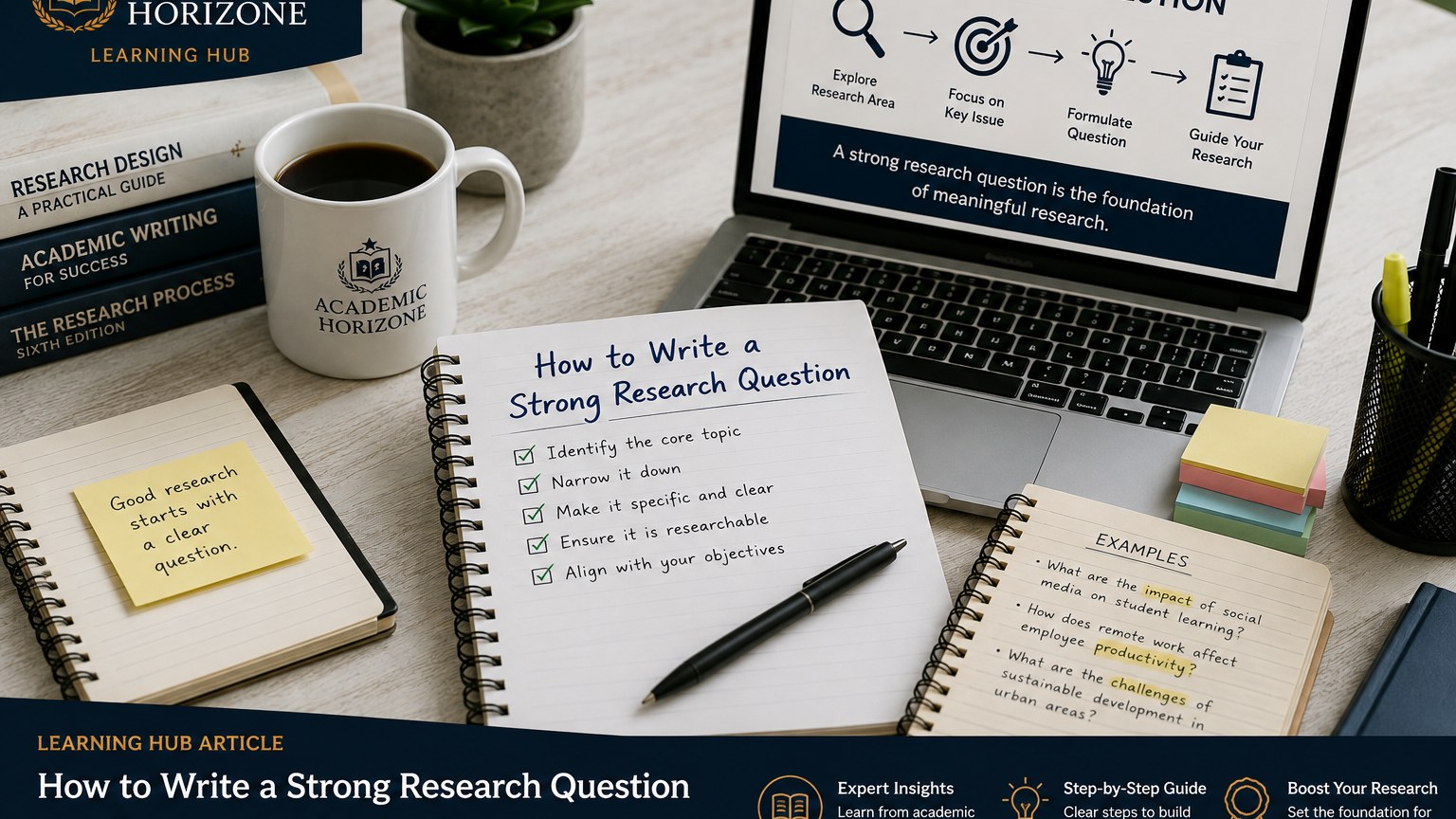
Your research question shapes everything that follows: what you read, what data you collect and how you write your conclusion. A weak question leads to a project that drifts. A strong question gives you a clear target. The quickest way to see the difference is through examples.
Below you will find weak and strong research question examples from several subjects, with an explanation of what changed each time. If you want the full step by step method for developing a question, see our guide on how to build a strong research question.
What makes a research question strong?
A strong research question is usually:
- Focused: narrow enough to answer properly within your word count and time.
- Researchable: answerable with data or sources you can actually access.
- Analytical: it asks how, why or to what extent, rather than simply what.
- Clear: its key terms are specific enough that two readers would understand it the same way.
- Worth asking: the answer matters to your field, to practice or to policy.
Weak and strong examples by subject
Illustrative examples: the questions below were written for this article to show how a question can be improved. They are not taken from real projects and do not describe real findings.
Business and management
Weak: What is employee motivation?
Stronger: How do flexible working arrangements influence the motivation of junior staff in small accounting firms?
Why it works: the stronger version names a factor, a group and a setting, and it asks how one thing influences another.
Education
Weak: Is homework good for students?
Stronger: To what extent do secondary school teachers believe that homework feedback improves students' independent learning?
Why it works: "good" is replaced with a specific outcome, and the question focuses on one group's views, which can be studied through interviews or surveys.
Psychology
Weak: Does social media affect people?
Stronger: What is the relationship between time spent on image based social media and body image satisfaction among first year university students?
Why it works: it defines the type of platform, the outcome and the population, and it asks about a relationship that can be measured.
Public health
Weak: Why do people not exercise?
Stronger: What barriers to regular physical activity do adults working night shifts in hospitals describe?
Why it works: it focuses on one group with a distinctive situation and asks for their own explanations, which suits a qualitative design.
Computer science
Weak: How can artificial intelligence be used in healthcare?
Stronger: How accurately can a machine learning model trained on publicly available chest X ray images classify pneumonia compared with a baseline model?
Why it works: it names the task, the data source and a point of comparison, so the result can be tested and evaluated.
History
Weak: What happened during the Industrial Revolution?
Stronger: How did local newspapers in one northern English town portray factory working conditions between 1830 and 1850?
Why it works: it limits the sources, the place and the period, and it asks about portrayal, which invites analysis rather than a narrative of events.
Law
Weak: Is data protection law effective?
Stronger: To what extent does current guidance on consent give small online retailers clear obligations when they collect customer data?
Why it works: it identifies the legal source, the type of organisation and the specific issue, so the analysis has a clear boundary.
Environmental science
Weak: How can we stop climate change?
Stronger: How do residents of one coastal town perceive the local council's flood adaptation plans?
Why it works: a global problem becomes a local, researchable question about perceptions of a specific policy.
The patterns behind the improvements
Look back at the examples and you will see the same moves repeated:
- Narrow the population. Replace "people" or "students" with a defined group.
- Narrow the setting. Add a place, type of organisation or time period.
- Define vague words. Replace "good", "effective" or "affect" with a specific outcome.
- Change the question word. Move from "what is" or "is it" to "how", "why" or "to what extent".
- Check the data. Make sure you know where the answer could come from.
Main questions and sub questions
Larger projects often use one main research question supported by two or three sub questions. Each sub question should cover one part of the main question, and together they should answer it fully. For example, the psychology question above could be supported by sub questions about how students use these platforms, how body image satisfaction is measured, and whether the relationship differs between groups.
A quick test for your own question
- Could you explain your question to a friend in one sentence?
- Do you know what kind of evidence would answer it?
- Could the answer be surprising, or is it obvious already?
- Can you finish the research in the time and word count you have?
If you answer no to any of these, refine the question using the patterns above. Your question will then form the core of your dissertation proposal.
Frequently asked questions
Can a research question be a statement?
Some projects use aims or hypotheses instead of a question, but they should be just as focused. Follow the format your department or supervisor expects.
How many research questions should I have?
Smaller projects usually have one main question. Larger projects may add a few sub questions. More questions are not better if they make the project unmanageable.
Can my research question change?
Yes. Questions are often refined as you read and collect data. Keep your supervisor informed of significant changes.
Related resources: how to build a strong research question, how to structure a literature review, and our dissertation timeline guide.
References
None. This article gives general guidance and does not cite specific sources.
Further reading
White, P. (2017) Developing Research Questions. 2nd edn. Palgrave.
Booth, W.C., Colomb, G.G., Williams, J.M., Bizup, J. and FitzGerald, W.T. (2024) The Craft of Research. 5th edn. University of Chicago Press.