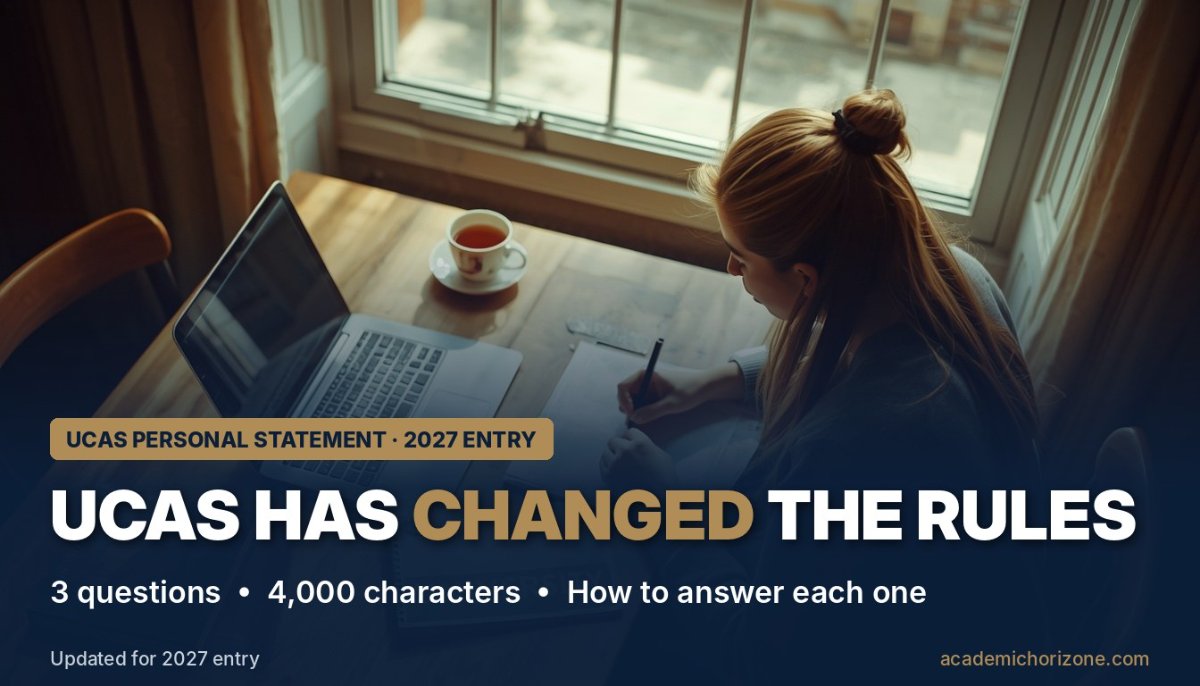
If you are applying to a UK university for 2027 entry, your personal statement looks different from the one your older friends wrote. UCAS has replaced the single long essay with three questions. The good news is that the new format is clearer. The challenge is that it leaves less room for padding, so every sentence has to earn its place.
This guide explains the three questions, what admissions tutors look for in each answer, how to plan your 4,000 characters, and the mistakes that make strong students sound ordinary.
What has changed in the UCAS personal statement?
From 2026 entry onwards, UCAS asks every applicant to answer three set questions instead of writing one free essay, and the same format applies for 2027 entry. You still write one statement in total, and it still goes to every university you apply to, but it is now divided into three sections.
- You have 4,000 characters in total, including spaces, shared across all three answers.
- Each answer must be at least 350 characters.
- Tutors read your answers together, so they should work as one piece about you.
Four thousand characters is roughly 550 to 650 words, which is less than most people expect. That is why planning matters more than ever.
The three UCAS personal statement questions
Here are the three questions, and what each one is really asking.
1. Why do you want to study this course or subject?
This is the heart of your statement, and it is the answer tutors care about most. They want to see genuine, specific interest, not a general love of learning. A strong answer explains what draws you to the subject and shows that you understand what studying it at university involves.
Start with a real moment or idea rather than a grand quotation. Compare these two openings:
Weak: "Ever since I was young, I have always been passionate about economics."
Stronger: "When fuel prices doubled in my town last year, I wanted to understand how the price of one product could change the way a whole community spent its money."
The second opening is personal and specific, and it leads naturally into the subject. Aim to spend about 40 percent of your characters on this answer.
2. How have your qualifications and studies helped you to prepare for this course or subject?
Here you connect what you have studied with what you want to study. Do not simply list your subjects, because tutors can already see them on your application. Instead, choose two or three examples and explain what they taught you.
Good material includes a project or extended essay, a topic that changed how you think, a skill such as data analysis or essay writing, and wider reading linked to your course. For each example, follow a simple pattern: what you did, what you learned, and why it matters for your degree.
About 30 percent of your characters is a sensible amount for this answer.
3. What else have you done to prepare outside of education, and why are these experiences useful?
This answer covers everything beyond the classroom: work experience, volunteering, part time jobs, online courses, competitions, clubs, caring responsibilities and independent projects. The key word in the question is why. Tutors are less interested in what you did than in what it shows about you.
A Saturday job in a shop can be more useful than a famous internship if you explain what it taught you about responsibility, communication or managing your time. Use the remaining 30 percent or so of your characters here.
How to plan your personal statement in five steps
- Research your course. Read the course pages and module lists of the universities you are applying to, and note the skills and topics that appear again and again.
- Collect your evidence. Write down every experience, book, project and achievement that could be relevant, even small ones. You will not use them all.
- Choose your best examples. Pick the few that show the most about you and fit each question best. Depth beats a long list.
- Write a first draft without counting. Get your ideas down first, then cut. Most strong statements start well over the limit.
- Edit for clarity and length. Remove repetition, filler words and anything a tutor could work out from your grades. Then read it aloud to check that it sounds like you.
What admissions tutors look for
Admissions tutors read a very large number of statements every year. The ones that stand out usually share three qualities:
- Specific motivation: a clear and believable reason for choosing this subject.
- Reflection: not just what you did, but what you learned and how it changed your thinking.
- Your own voice: natural, confident writing that sounds like a real person rather than a template.
Common personal statement mistakes to avoid
- Opening with a cliché, such as "I have always been passionate about…" or a famous quotation.
- Listing achievements without explaining them. One example explained well is worth more than five names.
- Repeating your grades or subjects, which tutors can already see.
- Writing for one university only. The same statement goes to all of your choices, so keep the focus on the subject rather than on one institution.
- Using someone else's words. UCAS checks statements for similarity, and a copied or ghost written statement can seriously damage your application. Your statement must be your own work.
- Leaving it to the last minute. A good statement usually takes several drafts over a few weeks.
Can I use AI to help with my personal statement?
Tools such as ChatGPT can help you brainstorm ideas or spot spelling mistakes, but a statement written by AI will not sound like you, and it could put your application at risk. UCAS expects your statement to be your own work. Our article Is using ChatGPT cheating? explains where the line usually sits.
Key UCAS deadlines for 2027 entry
For most courses, the equal consideration deadline for 2027 entry is 13 January 2027 at 18:00 UK time. The earlier deadline for Oxford, Cambridge and most courses in medicine, dentistry and veterinary science was 15 October 2026. Dates can change, so always confirm them on the official UCAS website and on each university's own pages.
Final checklist before you submit
- Each answer is at least 350 characters, and the total is no more than 4,000.
- Your first answer gives a specific, genuine reason for choosing the subject.
- Every example explains what you learned, not just what you did.
- You have checked spelling, grammar and punctuation carefully.
- A teacher or advisor has read it and given you feedback.
- It sounds like you when you read it aloud.
Get feedback on your own draft
A fresh pair of eyes can make a real difference. Our advisors offer one to one personal statement guidance. We ask the questions that help you find your own angle and give clear feedback on structure and clarity, while every word stays yours. As you plan, you may also find our guide to structuring academic writing useful.
Frequently asked questions
How long is the UCAS personal statement?
It is 4,000 characters in total, including spaces, shared across three answers. Each answer must be at least 350 characters.
Do I write a different personal statement for each university?
No. You write one statement, and UCAS sends the same one to every university you apply to.
When should I start writing my personal statement?
Ideally two to three months before your deadline, so you have time for several drafts and feedback.
Can someone check my personal statement for me?
Yes. Teachers, advisors and guidance services can give you feedback, as long as the ideas and the words stay your own.